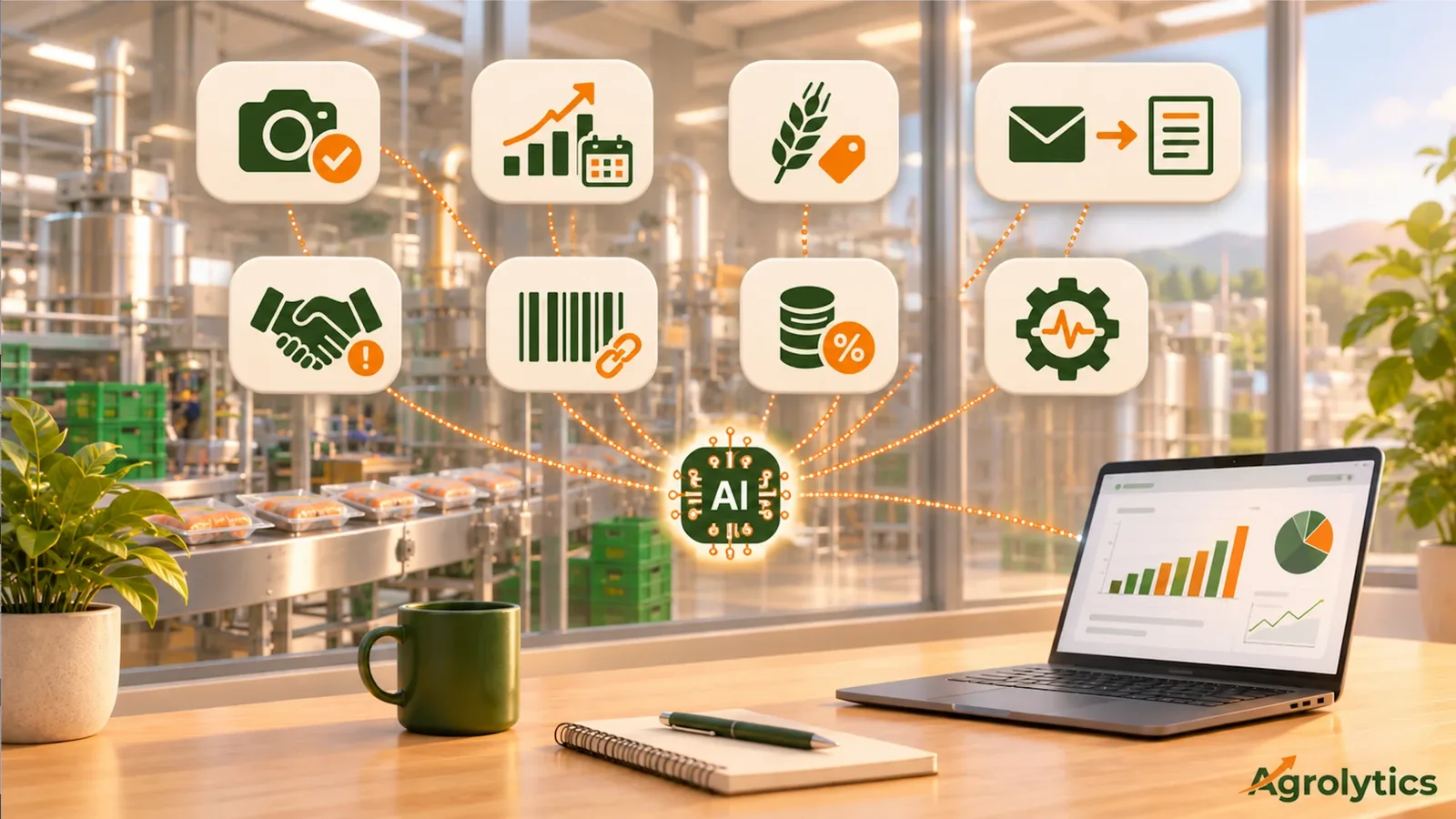
AI in the food industry means software that reads your data (images from the line, sales history, raw material prices, orders) to detect, forecast or prepare a decision. For an SME, the fastest gains are often in the office rather than on the factory floor: sales administration, purchasing, account management and margins, using data your ERP already holds.
This guide is for leaders of food and drink SMEs who want a clear view without jargon. It covers the four types of AI that matter in the sector, eight concrete use cases, real costs and a three-step method. Each use case links to an article that goes into detail.
Key takeaway
53% of French SMEs used an AI solution in 2026, up 19 points in a year. In the food industry, eight use cases cover most needs, from quality control to margins. Office projects (sales administration, purchasing, sales) start without sensors or a new ERP. The main obstacle is not the technology but data quality.
Where AI in the food industry stands in 2026
Adoption is accelerating. According to the French government's France Num 2026 survey, 40% of French micro, small and medium businesses use an artificial intelligence solution, and 53% of SMEs, 19 points more than a year earlier.
The size gap remains wide. In 2024, the French statistics office Insee found that 9% of companies with fewer than 50 employees used AI, against 33% of those with 250 or more. Large food groups started on the factory floor. SMEs have more to gain by starting with the functions where their teams spend hours re-keying and cross-checking data.
The 4 types of artificial intelligence that matter in food manufacturing
The word AI covers very different tools. Telling them apart avoids buying a factory solution for an office problem.
| Type of AI | What it does | Food industry example | Data required |
|---|---|---|---|
| Computer vision | Analyses images continuously | Spotting a packaging or colour defect on the line | Cameras and labelled images |
| Forecasting (machine learning) | Projects a value from history | Volumes to produce next week | Sales and production history |
| Generative AI | Writes, summarises, answers in plain language | Summarising a supplier specification sheet | Documents and text |
| AI agent | Chains tasks on your data and suggests an action | Preparing follow-ups for customers who are drifting away | ERP, orders, market prices |
The last two categories are often confused. Our article on generative AI vs AI agents for food SMEs explains the difference and what it means for a project.
8 use cases for AI in food manufacturing
The table gives the overall map. Each use case is then described in a few lines.
| Function | Use case | Starting data | Difficulty |
|---|---|---|---|
| Production | Vision-based quality control | Cameras on the line | High |
| Production | Forecasting and planning | Sales history | Medium |
| Purchasing | Anticipating raw material prices | Purchase prices, market prices | Low |
| Sales administration | Order entry and tracking | Orders, ERP | Low |
| Sales | Spotting customers who are drifting away | Order history | Low |
| Quality | Batch traceability | Labels, weights | Medium |
| Management | Margin tracking | Sales, cost prices | Low |
| Maintenance | Anticipating breakdowns | Machine sensors | High |
1. Vision-based quality control on the line
Cameras analyse each product and reject a defect before it becomes waste or reaches the customer. It is the most publicised use case, described for example by Kaizen Institute. It requires hardware and labelled images, so it mainly suits high-volume lines.
2. Sales forecasting and production planning
AI projects volumes per item from history, seasonality and promotions, then flags likely stock-outs and workload peaks. We explain it in AI agents and production planning.
3. Raw material purchasing
An agent compares your purchase prices with market prices, projects prices at 30, 90 and 120 days and simulates the effect of an increase on your margins before it hits. Details in AI for raw material purchasing.
4. Sales administration and order entry
The agent reads orders received by email or PDF, prepares their entry in the ERP and tracks anomalies. In a €12 million charcuterie business, a departing sales administrator was not replaced and revenue grew by 10%: see AI applied to sales administration.
5. Account management and customers drifting away
The agent spots a customer whose ordering pace is slowing or who has stopped reordering an item, and prepares a follow-up based on those facts. Details in the AI sales agent for the food industry.
6. Batch traceability
The agent reads supplier labels and records weights dictated by the operator, validated before they are sent to the ERP. Field feedback in a customer case in charcuterie.
7. Margin tracking by customer and product
The agent recalculates margins from sales and cost prices, then alerts you when a retailer or an item falls below a threshold. The topic is covered in margins in food industry SMEs.
8. Maintenance and energy
Sensors on refrigeration units or lines make it possible to anticipate a breakdown or a drift in consumption. Like vision, this use case requires prior instrumentation, so it rarely comes first in an SME.
The cost of an AI project in a food and drink SME
Cost depends first on the type of AI. Factory projects (vision, maintenance) require hardware and an integrator: that is a capital investment. AI agents connected to the ERP usually run on a subscription: at Agrolytics, €149 excl. VAT per month, per agent and per user, after scoping your process.
The right calculation compares this cost with the time freed up and the errors avoided. Our three-line method is detailed in calculating the ROI of sales AI. To compare offers, the 2026 comparison of AI agents scores them on eleven criteria.
What AI does not do for a food business
It does not fix wrong data. A customer under two codes or an outdated cost price produces wrong but convincing analysis. Start with the 6 ERP data flaws to fix.
It does not replace your teams. It takes over repetitive tasks (re-keying, cross-checking, follow-ups) and leaves the decision to the people who know the customers and products.
It is not used without a framework. Who may use which tool, with which data: an AI usage policy answers these questions and prepares you for the obligations of the European AI Act.
Starting an AI project in the food industry: 3 steps
Pick one problem that costs money. A repetitive task that takes someone several hours a week, or a decision made too late (a raw material increase, a lost customer). One measurable case beats an ambitious programme.
Check the data it relies on. Not the whole database: only the tables the chosen case needs. This is often the step that takes longest, and the one that decides the result.
Choose the right type of partner. An IT services firm, an agency and a specialist vendor do not bring the same things: our guide to choosing an AI vendor as a food manufacturer compares the three. For the full journey, follow the 7 steps of AI and data governance.
Frequently asked questions about AI in the food industry
Where should a food and drink SME start with AI?
With an office function where the data already sits in the ERP: sales administration, purchasing or account management. These projects need no sensors or cameras, are quickly measured in hours freed up, and serve as internal proof before moving to production. Pick one case, with a named owner and a baseline indicator.
How much does artificial intelligence cost for a food SME?
It depends on the type of AI. Industrial vision and predictive maintenance are hardware investments with an integrator. An AI agent connected to the ERP runs on a monthly subscription: €149 excl. VAT per month and per user at Agrolytics. Always compare this cost with the working time freed up, not with the price of standard software.
Do you need to change your ERP to use AI?
No. An AI agent connects to your existing ERP and reads its data, as our integration with EURAGRO shows. The real prerequisite is the quality of the data entered, not the software version. An old but well-kept ERP gives better results than a recent one full of duplicates.
What happens to our data with an AI tool?
Ask the vendor three questions: where the data is hosted, whether it is used to train a model, and who has access to it. Prefer European hosting, access limited to the tables needed and a written commitment not to reuse your data. These rules belong in your internal AI usage policy.
Is there funding for an AI project?
Yes, several public schemes support the digital transformation of SMEs. In France, they include diagnostics from Bpifrance, regional programmes and training funded by your skills operator (OPCO). Conditions vary by region and year. Check with your chamber of commerce or region before signing, as some schemes require an application beforehand. Amounts and what is actually funded are set out in our article on AI grants for food SMEs.
Further reading
If you read only one article next, choose what AI agents actually do for food SME leaders: it shows what a day looks like with an agent connected to your data.
Not sure which use case to launch first? Book 30 minutes with us: together we look at what your ERP already allows, and which of the eight use cases would pay off most for you.
Ready to take control of your data?
Book a 30-minute demo and see what Agrolytics can do for you.
Book a demo