You have used EURAGRO for years for your orders, your stock and your accounts. Here is what concretely changes when you plug in two AI agents that read that same data differently.
Thursday morning, 7:20
Nadia has run a family cannery for eleven years. Four and a half million in revenue, twenty-two employees, around thirty references sold to wholesalers, regional chains and a few delicatessens. EURAGRO has always run the business: orders, stock, accounts, everything goes through it.
That Thursday, before heading down to the workshop, she opens a message sent at 6:05.
There are three things in it. A wholesale customer has halved their orders over the past six weeks, without a single complaint recorded anywhere. One jar reference has been selling twice as fast as usual for ten days, and stock will not last the week if the pace holds. And a rise in the price of glass, announced the day before by a supplier, will eat into the margin on three references if nothing is renegotiated.
Nadia exported nothing, cross-referenced nothing, asked for nothing. All three pieces of information come from EURAGRO, the software she has used for eleven years. What changed is not her ERP. It is what is plugged into it.
Two complementary jobs: centralising and interpreting
EURAGRO does what it was designed to do for forty years, and does it well: centralising the orders, stock, production and accounting of a food business in a single reliable system. That foundation, built and refined over decades, is what gives CETRA informatique the trust of hundreds of food businesses.
That foundation already contains everything Nadia needs on Thursday morning: her wholesale customer's order history, her jar stock levels, her glass purchase prices. None of it existed outside EURAGRO. What took time was rereading it every week from a different angle: comparing a customer's orders across several periods, monitoring each reference one by one, cross-referencing a raw material price with manufacturing recipes.
That is an analyst's job, distinct from an ERP's job. Most food industry SMEs do not have that function in-house, and the owner does not have three hours a week to spare for it anyway.
Key takeaway
EURAGRO remains the source of truth. Marc and Sophie come and read that same data from a different angle, every week, to turn what is already recorded into a decision ready to be taken.
What Marc and Sophie do with EURAGRO data
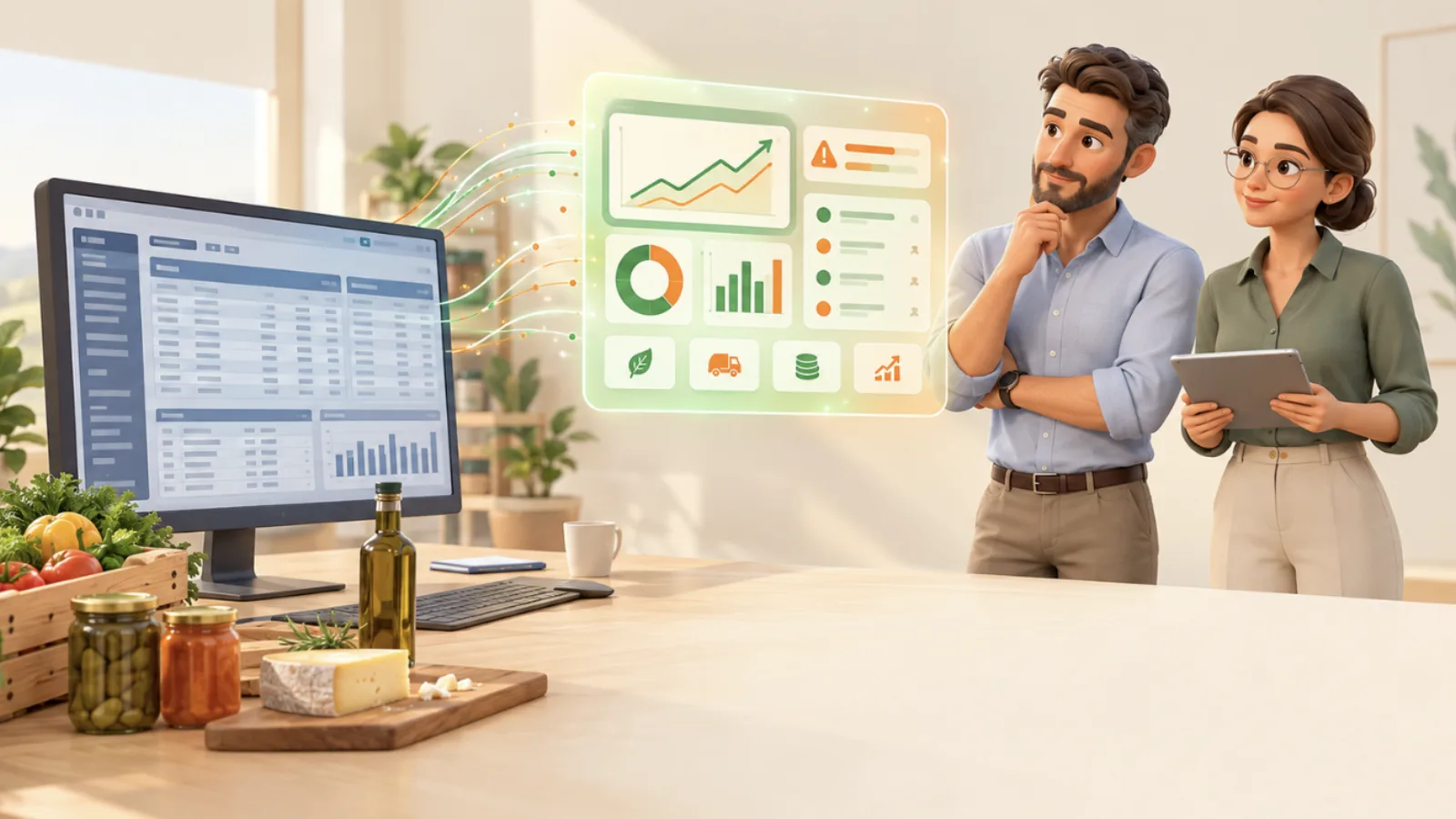
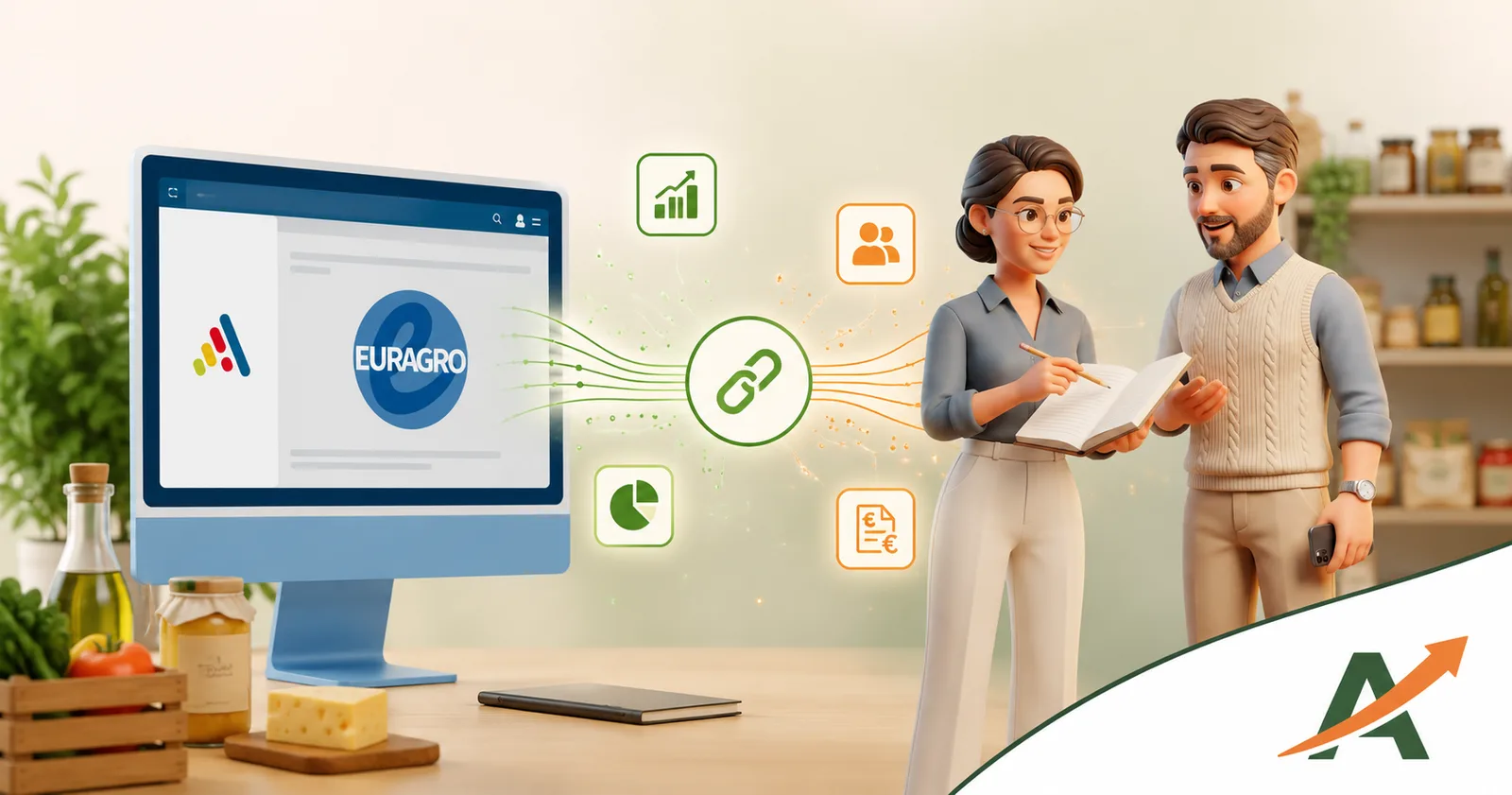
Agrolytics does not replace EURAGRO and does not ask you to change anything in it. The Marc and Sophie agents plug into the existing modules and add a reading that the ERP is not meant to do itself.
| EURAGRO module | What the agent adds |
|---|---|
| Orders and sales by customer | Marc detects accounts ordering less than usual and prioritises follow-ups before they drop off |
| Sales by channel and reference | Marc identifies accelerations and slowdowns by range, channel by channel |
| Stock | Sophie flags upcoming shortages and overstocks tying up cash |
| Purchasing and accounting | Sophie recalculates margins by product and by customer as soon as a raw material price or a selling price moves |
Each of these four modules is already solid in EURAGRO. What the agents add is the time to cross-reference them every week, across every reference and every account, with no intervention.
How the EURAGRO connection works in practice
This is often the first question from an owner who already has an ERP: does this mean a new IT project.
The answer is no, and that is precisely the point of the partnership formed with CETRA informatique, the publisher of EURAGRO. The connection is made with no development on your side:
- On the Starter plan, data is retrieved via Excel or CSV export from EURAGRO, a quick way to start taking back control of your data without changing any habits.
- On the Business plan, the connection is made directly to the EURAGRO database, with access set up alongside the CETRA teams, who know each customer's environment.
- In both cases, no data is endlessly duplicated or exposed without a framework: access is limited to what the agents need, and remains reversible.
The partnership with CETRA changes one thing above all: you are guided through the connection by someone who already knows your EURAGRO installation, rather than by a team discovering it.
What changes, week after week
Accounts that are slipping are seen before they leave. A customer spacing out their orders sends a signal before going to a competitor. Seeing it in week three rather than at the quarterly review changes what can still be done.
Shortages and overstocks are no longer discovered on the floor. A reference under strain or stock sitting idle either ties up cash or costs a sale, in both cases without anyone having decided it.
Raw material increases are passed on before they are absorbed. A price that climbs and is discovered on the invoice is margin quietly disappearing across every order placed in the meantime.
The owner gets management time back. What used to go into exports and pivot tables goes back into the decision itself: who to chase, what to produce, what to renegotiate.
Going further
The partnership between CETRA informatique and Agrolytics starts from a simple principle: an AI agent is not worth its technology, but what it is connected to. EURAGRO is the first building block of that connection for businesses that have sometimes used it for decades.
Marc, dedicated to commercial monitoring, and Sophie, dedicated to financial analysis, rely on the same logic whatever the ERP in place. To place Agrolytics against other ways of approaching AI in the food industry, our 2026 comparison details the strengths and limits of each approach, including our own. And to go back to the origin of this integration, the announcement of the partnership with CETRA informatique explains why the publisher of EURAGRO bet on AI.
Do you use EURAGRO and want to see what Marc and Sophie can draw from it for your own business? Book a 30-minute demo.
Ready to take control of your data?
Book a 30-minute demo and see what Agrolytics can do for you.
Book a demo