A confusion that slows down good decisions
For two years, artificial intelligence has entered many leaders' daily lives — often through the side door. An employee using ChatGPT to write an email. An assistant using it to summarise meeting notes. A sales rep asking it to prepare a customer presentation.
These uses are real and useful. But they have created a frequent confusion: many SME leaders now believe they have "already seen what AI can do", because they tested a generative tool and it did not bring them anything decisive for running their business.
It is not that AI is not useful for them. It is that they used the wrong kind of AI for the wrong problem.
Two technologies, two fundamentally different logics
Generative AI and AI agents are not two versions of the same tool. They are two approaches answering different needs, with opposite operating logics.
Generative AI produces content from an instruction. You ask it a question or give it a brief, and it generates an answer — a text, a summary, a list, a rewrite. It is excellent for anything involving creation, writing or document synthesis. But it does not know your data. It does not know what is happening in your business. And it does not act unless you ask it for something.
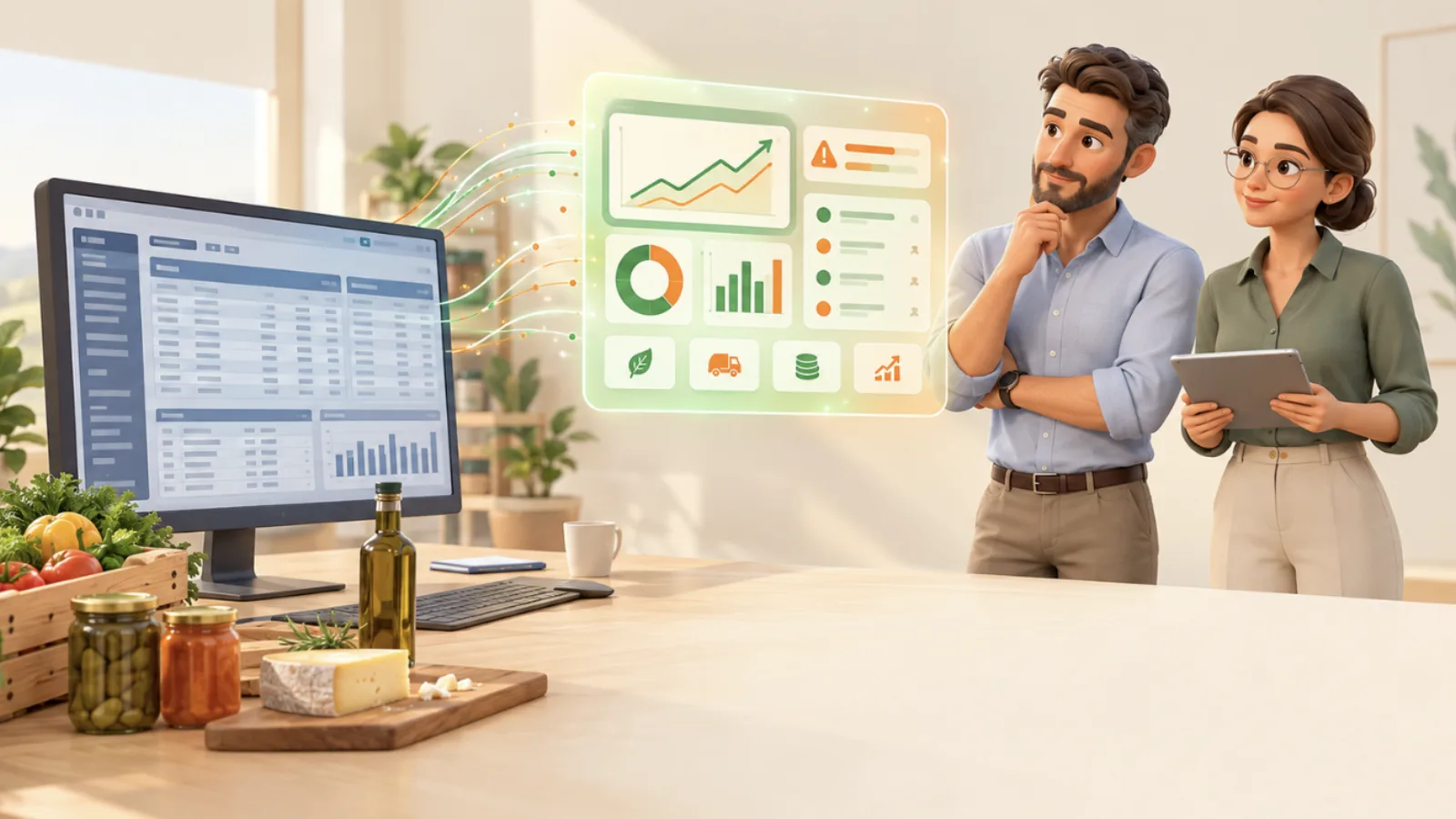
An AI agent monitors, detects and acts. It is connected to your tools — your ERP, your CRM, your email, your payroll files — and it monitors that data continuously according to criteria you have defined. When something changes, it does not merely flag it: depending on the level of autonomy you grant it, it can trigger an action directly in the tool concerned.
| Generative AI | AI agent | |
|---|---|---|
| What it does | Produces content on request | Monitors, detects and acts |
| What it knows | General knowledge | Your specific data |
| When it steps in | When you ask it a question | When something changes |
| What it replaces | Writing time | Monitoring and consolidation time |
| What it does not do | Monitor your business | Write, create, rewrite |
What generative AI does well — and its limits
Generative AI is a personal productivity tool. It speeds up tasks involving language: writing, rewriting, summarising, translating, structuring ideas.
In a food industry SME, its most natural uses are:
- Drafting a response to a tender or a commercial proposal
- Summarising a long supplier contract to extract the key points
- Preparing material for a sales meeting from scattered notes
- Rewriting a product sheet for a new market or a new distribution channel
These are real time savings on one-off tasks. But generative AI does not know your main customer has cut their orders by 30% this month. It does not know the wheat price has risen and that three of your references have fallen below the profitability threshold. It cannot alert you that your margin on a range has been eroding for six weeks.
For the simple reason that it has no access to that data — and that even if you supply it manually, it does not monitor it continuously.
What AI agents do — and what they can trigger
This is where the difference becomes concrete. An AI agent does not merely analyse: depending on how it is configured, it can take actions directly in your existing tools.
Connected to your ERP (Sage, Cegid, SAP Business One, Dynamics 365…)
The ERP is the main source of operational data in a food industry SME — orders, purchasing, stock, cost prices. An agent connected to your ERP can:
- Detect that a reference has fallen below its margin threshold and automatically generate an alert sheet for the sales manager
- Identify a drift between actual and budgeted purchase prices, and update cost prices in the system
- Consolidate a weekly activity report every Monday morning with no human intervention
Connected to your CRM (Salesforce, HubSpot, Pipedrive, Sellsy…)
The CRM holds the history of commercial interactions and customer data. A connected agent can:
- Detect that a customer has not ordered for an unusual length of time and automatically create a follow-up task in the CRM, assigned to the rep who owns the account
- Identify customers whose order volume is gradually falling and automatically add them to a priority watch list
- Update customer records with the latest order data from the ERP, with no manual re-keying
Connected to your email (Outlook, Gmail…)
Email is often the first point of contact for alerts and urgent requests. A connected agent can:
- Automatically send an alert email to the manager when a defined indicator crosses a threshold — margin below X%, a customer's orders down Y% over Z weeks
- Generate and send a structured weekly commercial summary to the management team, with nobody having to prepare it manually
- Detect quote requests in incoming emails and automatically create the corresponding opportunities in the CRM
Connected to your HR and payroll tools (Silae, Payfit, ADP…)
HR data is rarely integrated into SMEs' operational management, even though it has a direct impact on production costs. A connected agent can:
- Alert the manager when a month's payroll exceeds the defined budget, by cross-referencing payroll data with forecast budgets
- Detect anomalies in declared hours against planned schedules
- Consolidate the total labour cost per production line monthly, to feed it into cost price calculations
Connected to your financial management tools (Pennylane, QuickBooks, Sage Accounting…)
Cash and financial flows are critical indicators for any SME. A connected agent can:
- Monitor the cash balance and alert when a defined threshold is crossed
- Detect overdue customer invoices and automatically create reminders in the invoicing tool
- Consolidate a financial dashboard every month by aggregating data from several sources with no manual intervention
Two concrete situations to illustrate the difference
Situation 1 — A raw material increase
Your whole milk purchases rise 9% this month. You have a dairy range representing 35% of your revenue.
With generative AI: if you manually submit your purchasing data and your cost prices, it can help you structure an argument to renegotiate your prices with your distributors, or draft an email briefing your sales team. It is useful once you have identified the problem and decided to act.
With an AI agent: as soon as the increase is recorded in your ERP, the agent automatically calculates the impact on every reference in your dairy range, identifies those whose margin falls below your threshold, sends an alert to sales management in Outlook, and creates a task in the CRM to start the price review with the customers concerned. You asked for nothing — the chain of action triggered on its own.
Situation 2 — A customer ordering less
Your second-largest customer by volume has gradually reduced their orders over five weeks. Their overall revenue stays within an acceptable range, so nothing alerted you.
With generative AI: if you submit the order history, it can help you prepare a recovery plan or draft an approach. Useful — but after you have identified the problem.
With an AI agent: the anomaly is detected in week two. The agent automatically creates a follow-up task in the CRM for the rep who owns the account, sends a summary of the situation to the manager by email, and adds the customer to a watch list. You act six weeks earlier.
Do you have to choose between the two?
No — and that is an important point. These two kinds of AI answer different needs and can coexist in the same organisation.
Generative AI is relevant for one-off individual tasks — writing, rewriting, summarising. It is used on demand, on subjects involving language.
AI agents are relevant for continuous collective management — monitoring, consolidating, triggering actions. They are used in the background, connected to the tools that hold your real data.
Key takeaway
the question is not "generative AI or AI agent?" but "what problem am I trying to solve?". If the problem is a lack of time on writing tasks, generative AI is the right answer. If the problem is a lack of visibility on what is happening in your business — and a lack of responsiveness when it changes — an AI agent connected to your tools is what you need.
What it changes for a food industry SME in 2025
According to the France Num 2025 barometer, 15% of food industry businesses already use an AI solution — a figure multiplied by 2.5 in one year. In the vast majority of cases, these uses are concentrated on generative AI: text generation, information search, conversational assistants.
That is a useful starting point. But the most significant gains for a leader whose central problem is managing profitability in a context of rising costs lie on the AI agent side — connected to the tools that already hold their data, able to act without waiting to be asked a question. To see what that difference looks like in one specific role, we have detailed what an AI sales agent changes for a food industry sales team, task by task.
Want to see concretely what an AI agent can do on your data? Book an Agrolytics demo — in 30 minutes, we show you how this kind of tool fits into your existing management.
Ready to take control of your data?
Book a 30-minute demo and see what Agrolytics can do for you.
Book a demo