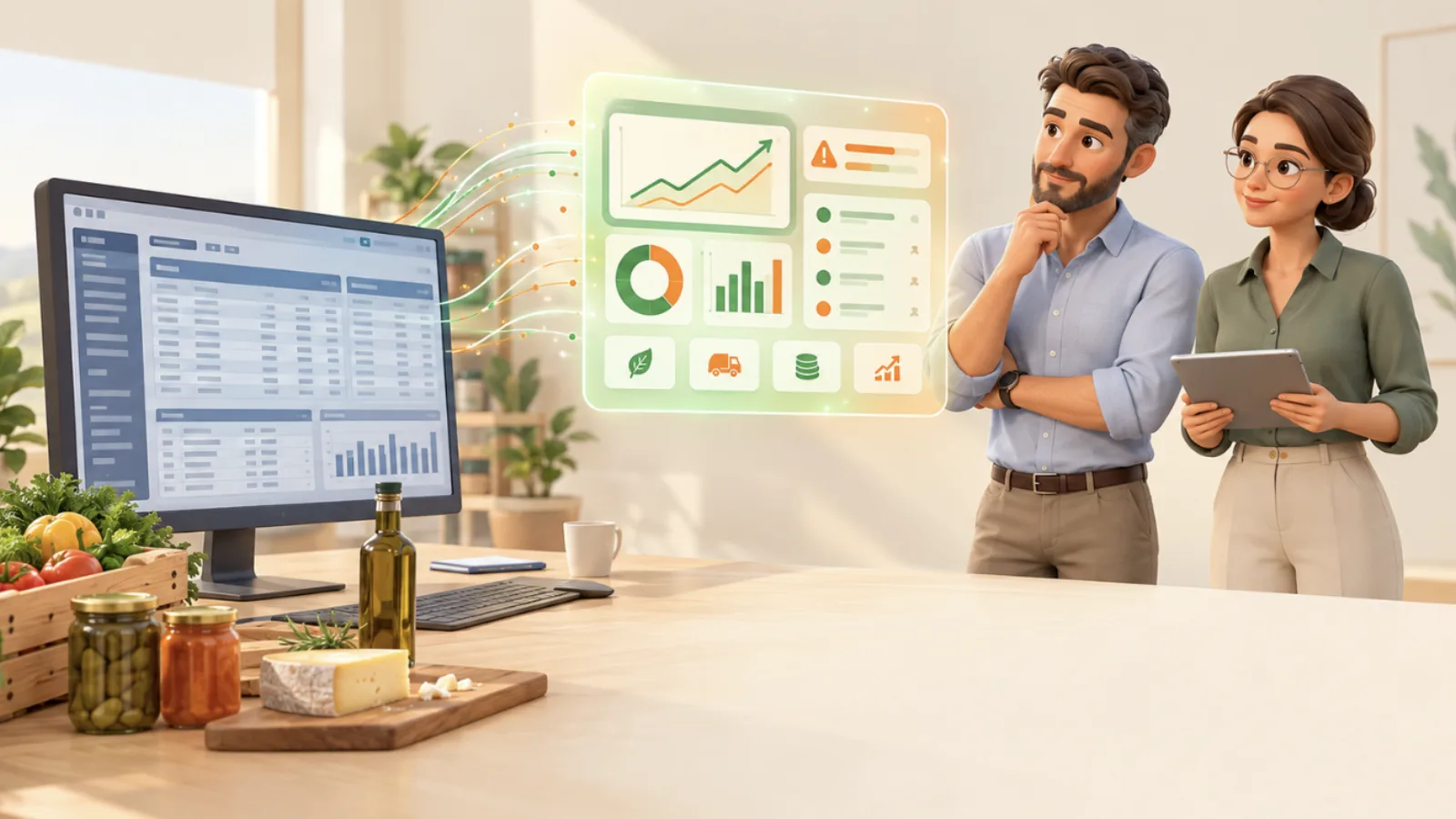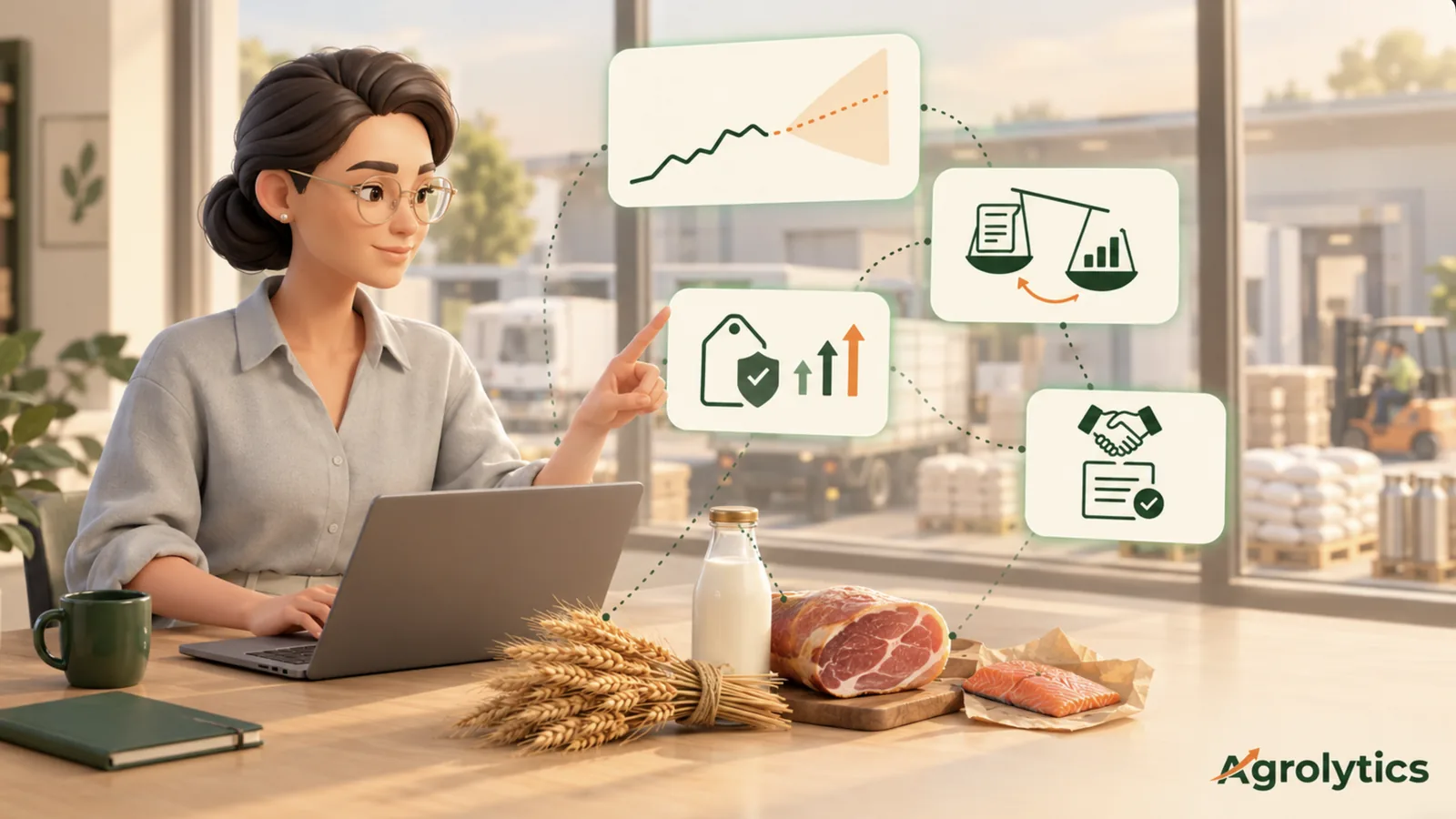
In the food industry, AI applied to raw material purchasing does three things a spreadsheet cannot do on its own: it projects prices 30, 90 and 120 days ahead using a regression on twelve months of history, it compares every price paid with the market quotation on the invoice date, and it simulates the effect of a price rise on the margin of every product.
At Agrolytics, this is the job of Sophie, our AI finance agent. She tracks the prices of your raw materials, compares them every day with your purchase invoices and calculates what each rise would cost your margins. This article explains how she runs these calculations, use by use, along with their limits. It is written for purchasing managers, management controllers and managing directors of food and drink SMEs who want to understand the method, not just the promise.
The 4 uses covered
project the price of each raw material 30, 90 and 120 days ahead to choose when to buy; compare what each supplier charges with the market price to know who to renegotiate with; simulate a rise on the margin of every product to know which ones to protect; document the price revision clause to negotiate with your customers, figures in hand.
AI raw material purchasing: what the agent calculates that a spreadsheet does not
In many food and drink SMEs, raw material tracking lives in an Excel file: one tab per material, prices noted by hand, invoices re-keyed at month end. The file tells you what happened. It rarely tells you what will happen, or what it costs each product.
| Task | In a spreadsheet | With an AI agent |
|---|---|---|
| Track market prices | Manual, weekly at best | Quotation pulled in every day |
| Project prices | Rarely done, trend drawn by eye | 12-month regression, recalculated every evening, with a margin of error |
| Compare suppliers with the market | Different units, mismatched dates | Price converted per kilo or per tonne, quotation on the invoice date |
| Measure the impact on margin | One file per scenario | Several scenarios across all products |
We described price monitoring in our article on AI agents connected to market data. Here, the focus is on what the buyer and the managing director do with that information.
4 uses of AI for raw material purchasing in the food industry
To keep things concrete, take a charcuterie maker buying pork, whose reference price is the Breton pig market in Plérin. The method is the same for a miller's wheat, a cheesemaker's milk or a smokehouse's salmon.
1. Raw material price forecasting at 30, 90 and 120 days
The buyer has to decide today on a volume they will pay for in six weeks, and the managing director has to set customer prices for the next quarter. Both are reasoning about a future price that nobody gives them.
The agent fits a linear regression on the last twelve months of quotations for each material. The model has two components. The trend captures the direction of the price over the year. Seasonality captures what comes back at the same time each year: pork, for example, follows a marked annual cycle. Every evening, the latest quotation is added to the history, the model is re-estimated and the 30, 90 and 120-day projections are updated.
Every projection is shown with its margin of error. It widens with the horizon: the 120-day projection is less certain than the 30-day one, and the tool shows this rather than hiding it. A narrow margin signals a steady market you can rely on. A wide margin signals a volatile market, where it is wiser to secure part of your volumes.
Each horizon serves a different decision. At 30 days, the timing of the next orders. At 90 days, the negotiation of supplier contracts. At 120 days, the purchasing budget and customer prices for the next period.
A projection does not say what will happen. It says what will happen if the past year carries on, and within what margin.
2. Supplier price comparison against the market price
Comparing two suppliers with each other is not enough: both may be expensive. The real question is the gap between what you pay and what the material is worth on the market on the day you buy it.
The agent converts each invoiced price into the unit of the quotation, per kilo or per tonne depending on the material, then compares it with the quotation on the invoice date. The source is the one you choose: Euronext for wheat, maize or rapeseed, the Breton pig market for pork, FranceAgriMer for milk and fresh produce, or your trade body's index. The gap is calculated in euros and as a percentage, invoice by invoice and supplier by supplier.
A gap is not an anomaly in itself. Transport, processing, quality, certification or packaging justify a premium. What matters is how it moves. A stable gap is a premium. A gap that widens when the market falls is a supplier who passes on rises quickly and falls slowly.
That gap curve is your best argument with the supplier.
3. Margin simulation when raw material prices rise
A rise in a raw material does not hit every product the same way. A cooked ham, where pork weighs heavily in the cost price, takes the full force of the shock. A terrine, where the meat is diluted among other ingredients and labour, feels it less.
The agent simulates rise scenarios on one or more materials and calculates, for each product, the new cost price and the resulting margin. The calculation follows the material's share of the cost price: if pork accounts for 55% of a product's cost, a 10% rise in pork increases that cost by 5.5%. The output is a list of the products that would fall below your margin threshold, ranked by loss in euros.
A good habit: take the upper bound of the 90-day projection as your pessimistic scenario. We cover this management approach in our article on margins in food and drink SMEs.
You know which products to protect before the rise reaches the invoice.
4. Price revision clause: arrive at customer negotiations with the figures
In France, Article L443-8 of the Commercial Code, in the version in force since 20 August 2026, requires food sales agreements to include an automatic revision formula for the price list, upwards and downwards, based on changes in the cost of the agricultural raw materials they contain. It is one of the central mechanisms of the EGalim laws.
You still need to be able to show the change. The agent builds the file: how the chosen index moved over the period, the material's share in each product, the impact in euros per unit sold. You walk into the meeting with a calculation the retailer's buyer can check, not a vague sense that prices have gone up.
For how to pass on a rise customer by customer, see our article on data-driven management in food and drink SMEs.
A documented rise negotiates better than an announced one.
Summary: from purchasing data to decisions
| Use | Input data | What the agent produces | Decision it enables |
|---|---|---|---|
| Price forecasting | 12 months of quotations | 30, 90 and 120-day projections with margin of error | Purchase timing, budget, pricing |
| Supplier comparison | Invoices and quotation on the day | Gap to market per supplier, in euros and % | Supplier renegotiation |
| Margin simulation | Scenarios and cost prices | Margin per product after a rise | Products to protect |
| Revision clause | Index and material share | Costed file per product | Customer negotiation |
What AI doesn't do for your raw material purchasing
It does not predict shocks. The regression extends the trend and seasonality of the last twelve months. A drought, an animal disease outbreak or an embargo is not in the history, and the margin of error does not cover it.
It does not place your orders. Buying, shifting a volume or changing supplier remains the buyer's decision. Nor does the agent manage your stock today.
It does not replace a hedging strategy. A projection helps you choose when to buy. It does not protect you the way a futures contract or a negotiated fixed price does.
It depends on your purchasing data. A miscoded invoice or a wrong unit distorts the gap to market. The first few weeks are also used to make this data reliable.
Frequently asked questions about AI and raw material purchasing
How reliable is a 120-day price projection?
The steadier the market, the more reliable it is. The projection extends the trend and seasonality of the last twelve months, and each horizon is shown with its margin of error, wider at 120 days than at 30. It is there to guide a budget or a purchasing schedule, not to guarantee a price. It does not predict shocks that are absent from the history.
Which raw materials can be tracked?
Any material with a regular quotation: cereals, oilseeds, pork, milk, seafood, fruit and vegetables. You choose the reference source for each material, whether Euronext, the Breton pig market, FranceAgriMer or a trade body index. The price is converted per kilo or per tonne, depending on how the material is usually traded.
Do I need an ERP to analyse raw material purchasing?
No. An Excel or CSV export of your purchase invoices is enough to start: date, supplier, material, quantity, price. If you have an ERP, the agent can connect to it via API, CSV export, SFTP or direct database access, and invoices then flow in automatically every day.
How much does an AI agent for purchasing cost?
The first agent costs €149 excluding VAT per month, on an annual commitment paid monthly or upfront with a 10% discount. Each additional agent costs €79 excluding VAT per month.
Do our purchase prices stay confidential?
Yes. Your data is hosted in France, encrypted, and never shared or used for any other purpose. We set out these rules in our article on data governance in a food industry AI project.
Going further
These four uses are the purchasing side of our guide to margins in food and drink SMEs and how to regain control of them. To link price projections to the volumes you need to produce, see also our article on AI agents and production planning.
Book 30 minutes with us: we take one of your raw materials, load a few months of invoices, and show you the gap Sophie finds between the prices you pay and the market, supplier by supplier.
Ready to take control of your data?
Book a 30-minute demo and see what Agrolytics can do for you.
Book a demo