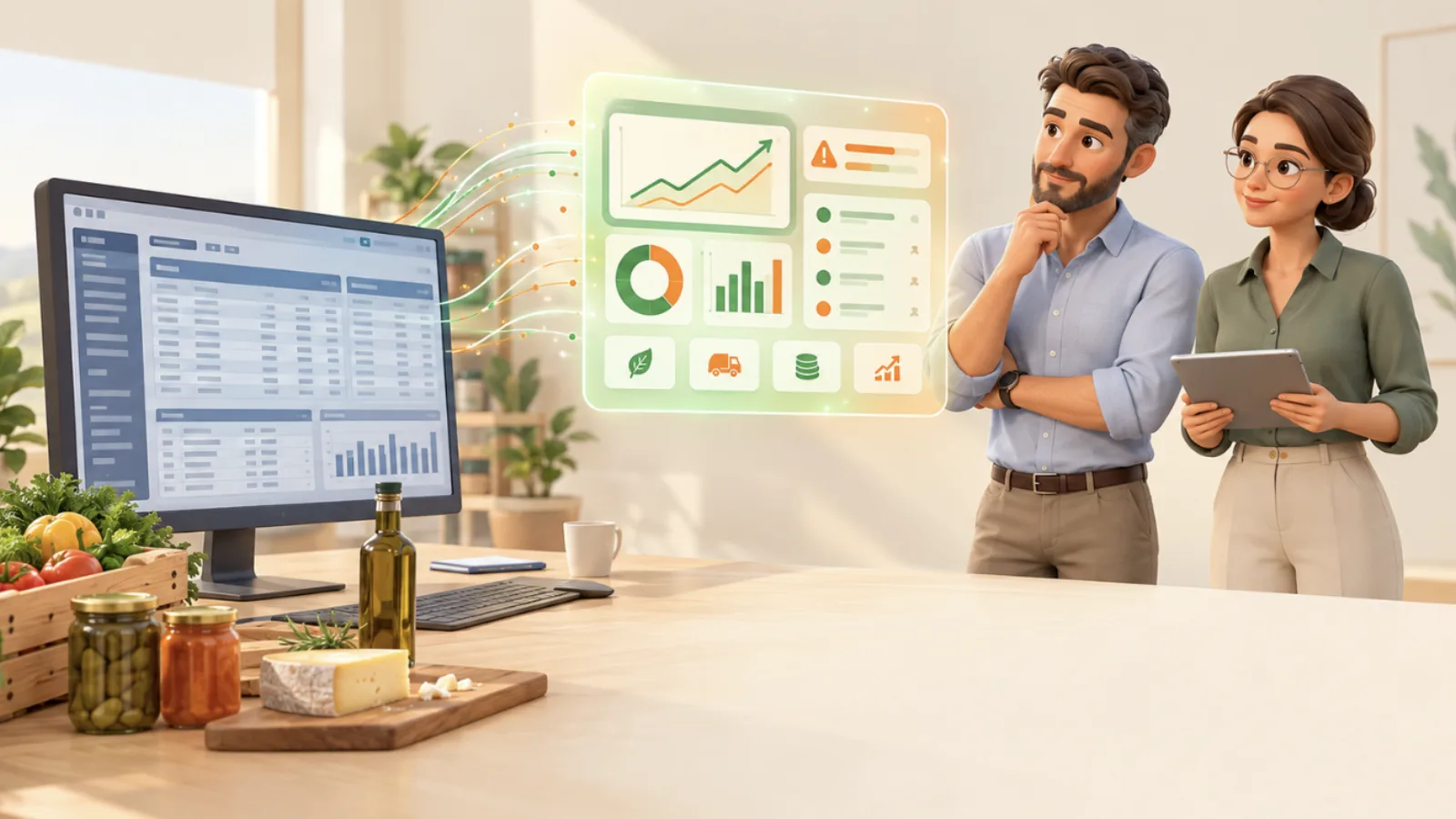
AI for sales administration in the food industry takes over the repetitive side of the job: invoice reminders, tracking customers who order less, customer files, the weekly sales report. At a charcuterie maker with €12m in revenue, it meant a sales administrator who left in February did not need replacing, while revenue grew by 10%.
To our knowledge, this is one of the first AI use cases in the food industry whose impact shows up directly in the accounts. Here is how it played out, task by task.
Key takeaway
a sales administration team that went from three people to two with no new hire, €55,000 a year in fully loaded cost avoided, revenue up 10% from February to September 2026 compared with 2025, and a one-week rollout.
Food industry AI case study: a charcuterie maker, three sales administrators, one resignation
Our client is a charcuterie maker with €12 million in revenue. Its customers: supermarket chains, wholesalers, foodservice, delicatessen butchers. Three people run sales administration.
In February 2026, one of the three resigns, at the very moment we are connecting our sales agent to the company's tools. The managing director decides to hold off on hiring and see what the agent can absorb. Eight months later, the role has not been filled, and nobody has asked for it to be.
Sales administration in the food industry: where the hours go
A sales administrator's week mixes two kinds of work. The kind that creates value: a complicated order, a dispute with a central buying office, a stock-out to manage. And the kind that consists of searching, copying, chasing and formatting.
| Task | Frequency | Value created |
|---|---|---|
| Order entry and follow-up | Daily | High, the core of the job |
| Disputes, credit notes, stock-outs | Daily | High, customer relationship |
| Invoice reminders | Weekly | Low, but affects cash flow |
| Looking up history before a call | Several times a day | Low |
| Spotting customers who order less | Rarely done | High, but neglected |
| Sales report for management | Weekly | Low |
Low-value tasks overflow, high-value ones get postponed. That is exactly where an AI agent fits.
AI agent for sales administration: 4 tasks taken over
The durations below are orders of magnitude observed at this client and our other equipped clients.
1. Invoice reminders
Every week, someone had to pull the overdue invoices, check for pending credit notes, then write a reminder for each customer. The task everyone puts off, even though late payments in France still averaged 13.4 days at the end of 2025, according to the Banque de France Payment Terms Observatory.
The agent drafts reminders from each customer's due dates and payment history, with a tone suited to the usually punctual payer as well as the chronic late one. The sales administrator reviews and sends. Around 4 hours a week given back to the team, and cash comes in sooner.
2. Customers who order less
A wholesaler goes from one order a week to one every ten days. A delicatessen has not reordered the pâté en croûte for a month. The signal is in the order history, but nobody has time to look for it.
The agent tracks the rhythm and mix of each customer's orders and alerts the sales administrator as soon as a gap appears, with the context: since when, which products, what volume. Around 2 hours a week per sales administrator, on work that was almost never done. This is probably where part of the growth came from.
3. Customer files
Before each call, a sales administrator had to piece the context back together: latest orders, last dispute, recent emails, negotiated prices. The agent keeps each file up to date from emails and order history. Around 2 hours a week per sales administrator, and better-prepared calls.
4. The weekly sales report
On Mondays, a sales administrator pulled sales by customer, channel and product family for the managing director. Marc, our sales agent, now produces this report automatically, showing what is growing and what is slipping, and the managing director asks it questions directly. Around 2 hours a week per sales administrator.
Replace a sales administrator or refocus the team?
In total, around 16 hours a week given back to the team, close to a half-time role. The two sales administrators did not use it to mechanically absorb their former colleague's workload, but to refocus on what creates value: complex orders, disputes, customers called back at the right time. The rest of the workload disappeared along with the searching and formatting.
The agent is not smarter than a sales administrator. It is more consistent: it never forgets a reminder and never lets a customer drift away unnoticed. The sales administrators remain better at judgement and relationships. That division of work is what makes it succeed.
AI sales administration in the food industry: results after eight months
| Indicator | February 2026 | September 2026 |
|---|---|---|
| Sales administration headcount | 3 people | 2 people |
| Cost of the unfilled role | €55,000 a year fully loaded | Around €37,000 saved over 8 months |
| Revenue | 2025 baseline | +10% from February to September |
| Time given back by the agent | None | Around 16 hours a week for the team |
If the trend holds over the year, each sales administrator will be handling around €6.6m in revenue, against €4m before the departure. This is a projection, not a measured result.
What AI doesn't do in sales administration
It does not explain the 10% growth on its own. Prices, seasonality, new listings and the sales reps' work all contribute. What is certain is that the company absorbed a departure without losing revenue.
It does not manage the customer relationship. A dispute with a buying office or an urgent order to squeeze in remain human matters.
It does not decide. Sending a reminder, calling a customer back or granting a commercial gesture remains the team's decision.
How to automate sales administration: where to start
List the tasks the team keeps putting off. Invoice reminders, customer follow-up, reporting: that is where the gain is fastest.
Measure before you connect. Record the time spent on these tasks and your average payment delay, so you can prove the result.
Wait before you hire. When someone leaves, give the tool a few weeks before reopening the role.
Frequently asked questions about AI for sales administration
Can AI replace a sales administrator?
Not entirely. AI takes over the repetitive tasks of sales administration: invoice reminders, looking up history, tracking customers who order less, reporting. Disputes, complex orders and the relationship with buyers remain human. At our client, it meant a departure did not need replacing, because the two remaining sales administrators could focus on those matters.
Which sales administration tasks should be automated first?
Invoice reminders and tracking customers who order less. The first gives the team back around 4 hours a week and speeds up payments. The second protects revenue, on work the team almost never has time for. Both rely on data the company already holds.
How long does it take to set up an AI agent for sales administration?
One week at our client. The agent connects to the existing management software and mailboxes, with no migration and no heavy IT project. The first alerts and drafted reminders arrive by the end of that week, and the team needs no particular technical skills.
Does customer data stay within the company?
You choose which data the agent can access, and the flow goes one way only: the agent reads, it changes nothing in your tools. We set out these rules in our article on data governance in a food industry AI project.
Is it worth it for a small sales administration team?
Yes, often more than for a large one. In a team of two or three, a single absence or departure immediately disrupts the service. The agent provides continuity: reminders go out, customers who drift away are flagged, the report arrives, even with a reduced team.
Going further
This case shows what an AI sales agent changes for a food and drink SME. To estimate the gain for your own business, follow our method to calculate the ROI of sales AI in the food industry, or see the full range of AI agent use cases in the food industry.
Book 30 minutes with us: we look at your order and invoice history, and show you the reminders and at-risk customers the agent would have flagged this week.
Ready to take control of your data?
Book a 30-minute demo and see what Agrolytics can do for you.
Book a demo